Snuggled up in a warm bed in my heated cabin, my mind ran through the various excuses I might use to get out of going fishing. I could hear the winds howling. Overnight, the blow increased significantly. A glance through the ice-framed window revealed what I had feared — a white-washed world. A blizzard shot snow horizontally across the frozen fjord.
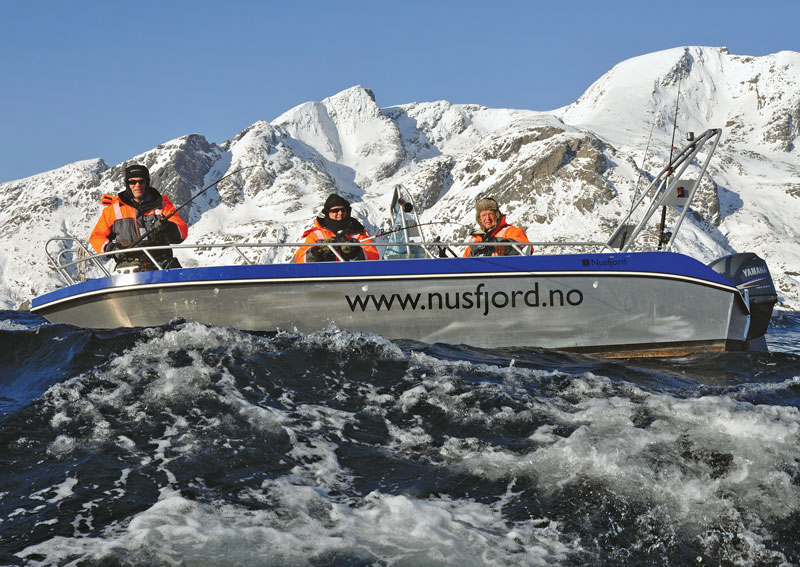 Conditions are challenging in the North Atlantic off Norway, but the rewards are gigantic codfish.Dave Lewis
We’d fished the previous day, initially with much enthusiasm following the sight of a 60-pound cod in the camp’s filleting shed. We left the shelter afforded by the high peaks flanking the fjord at Lauklines on the north coast of Norway and headed toward our destination about 20 miles offshore. We steamed into the cold, gray and grumpy-looking North Atlantic. The boat started to pitch and roll heavily in the increasingly confused seas.
The subzero temperature combined with strong winds and rough seas made matters worse — it was brutally cold. Some sought shelter in the spacious, heated cabin, the worst place to be if you are feeling ill on a rolling boat. Others stood outside in the frozen air risking hypothermia.
Those of us who could, fished hard and were rewarded with beautifully conditioned codfish, the larger specimens weighing in the low 30-pound range. By midday, more than half of the crew had succumbed to the downward spiral of mal de mer as conditions deteriorated. I must admit, I felt an enormous sense of relief when the captain decided to head back to the harbor.
 Codfish from 50 to nearly 100 pounds are found in the cold, rough waters. Dave Lewis
Marcus Ahlund, our host and guide, came around early on day two with news that we’d be sailing at 0700, adding that the skipper “thought conditions might ease a little in the afternoon.” It had taken a monumental effort to crawl out of bed, drink coffee, pile on layers of my warmest gear, and leave the snug cabin to wade 50 yards through deep snow to the boat — all while wondering if it was too late to fake an illness.
I had traveled to Norway to fish for skrei, the famous run of giant cod that migrate from the rich feeding grounds in the Barents Sea off northern Russia to the Norwegian coast to spawn. These fish are the largest cod found anywhere in the world, and over the years I had attempted to intercept the run on several occasions. On many trips, we were unable to fish the most productive areas due to foul weather, but that’s part of the deal in the dead of winter at these far-north latitudes.
During a February trip, I caught my personal best cod, a 55-pounder taken at Jøkelfjord, a small sheltered fjord within a fjord many miles inland from the sea. Jøkelfjord is situated just above the 70th parallel in Arctic Norway, 540 nautical miles farther north than Anchorage, Alaska.
 Fishing for codfish in Norway is not for the faint of heart. Dave Lewis
Tucked away on the eastern flank of Kvænangen fjord, Jøkelfjord is a place where the steep, snow-covered escarpment plunges almost vertically to the water’s edge. From there, it continues into clear water to create soundings in excess of 300 feet within spitting distance of shore. Eagles, otters and whales hunt here, and on rare occasions, wolves have been seen scavenging the rock-strewn beaches. A spectacular backdrop of an ancient glacier frames the area, its tongue of compressed blue ice spilling over the mountain peaks at the end of the fjord, then sliding imperceptibly toward the sea.
Within Jøkelfjord and many of the other fjords throughout the Nordland, Troms and Finmark regions of northern Norway, you often find shoals of silver herring so thick that the normally glassy-calm surface boils with life. The multitudes of herring are attracted by the eggs laid by spawning cod, and the bait, in turn, attracts other fish, including halibut, wolffish, resident coastal cod that do not migrate and coalfish, which are called pollack in the United States.
In recent years, perhaps as a result of changing sea temperatures, traditional skrei spawning areas such as Jøkelfjord have not seen the numbers of fish that were once commonplace. The most productive areas moved offshore into open water outside the fjords — and that’s where we were headed.
 Anglers seeking world-record codfish would be wise to plan a trip to Norway. Dave Lewis
Several uncomfortable hours after pushing away from the dock, a sharp reduction in engine revs confirmed that we had arrived at the fishing grounds. As our lures swiftly disappeared, falling toward the seabed 200 feet beneath, word from the wheelhouse announced dense shoals of cod beneath us. Within minutes of starting to work our heavy, metal spoons and oversized soft-plastic jig heads, all rods bent into fish.
My first cod wouldn’t have made 10 pounds, but on the next drop my rod bent savagely and started to bounce to the tune of what was a far more substantial fish. Bracing myself against the rail as the boat pitched and rolled, I worked the fish toward the surface. When I finally caught a glimpse of it, all thoughts of struggling in rough seas were forgotten. Gaffed and swung up over the gunwales, the fish crashed onto the deck with a solid thump. It tipped the scales at 45 pounds.
During the first couple of hours, we caught a staggering number of cod. The fish averaged 20 to 30 pounds, and several weighed more than 40. At least one monster came in at 50-plus pounds. Our captain, Cato Hansen, joined us on deck with a rod, and in the way captains the world over are annoyingly good at doing, he immediately hooked into a much bigger fish. When a man who has fished for cod off northern Norway all of his life gets visibly excited about fighting a fish, it’s time to sit back and enjoy the show.
 Cod fillets hung in traditional Norwegian fashion.Dave Lewis
Hansen worked the fish for 10 minutes, and when it finally came into view, everyone on board gasped. It took two men to heave the behemoth onto the deck. It was the largest cod I had ever seen, confirmed by the needle on the scale — 31 kilograms, more than 68 pounds.
We were in cod heaven, despite the conditions. No one had time to think about being cold or sick. We all knew that each drop could produce the Holy Grail of cod fishing: the first-ever 100-pound cod landed on rod and reel. Hansen had heard on the radio that one of the commercial boats fishing the same area and using jigs, as we were, had boated a fish of 55 kilograms, an amazing 121 pounds.
As the day progressed, the average size of our fish was more than 30 pounds. By the end of the day, we had caught 10 cod over 50 pounds. Ahlund, our guide, caught our second 60-pounder — 61 pounds, 4 ounces to be exact — and didn’t get overly excited. The previous year he had caught an 81½-pound giant. I never thought I’d spend a day fishing for cod and not even bother to grab my camera for anything less than 50 pounds.
 When conditions are too rough to head offshore, anglers can switch it up and do a little ice fishing. Dave Lewis
Around lunchtime, the fishing eased a little, giving us a chance to take stock of the morning, stretch aching limbs, eat, drink some hot coffee and reflect on a very special morning. Hansen used the break to slowly cruise around the area looking for signs of fish before stopping over yet another huge shoal that the sounder showed extended from the seabed up more than 60 feet in the water column.
The prospect of hooking something remarkable kept us fishing in finger-numbing, face-freezing conditions. After many fish were reeled in, Kim Eirik’s dream came true. Eirik had been steadily catching fish all day and broken his personal best twice, which now stood somewhere in the high 50s. Then he hooked another very big cod. For 15 minutes, he slowly worked the fish toward the surface. When it came into view, there was a hush of disbelief, followed by a loud cheer. A few minutes later, the scales confirmed Eirik’s fish weighed an amazing 73 pounds, 4 ounces.
A Storied Fishery
The annual skrei run occurs from January through April in the most challenging sea conditions I have experienced in the North Atlantic, but the rewards are well worth the effort. Nowhere else will you stand a better chance of catching cod weighing more than 50 pounds than the far north of Norway. The long-standing IGFA world record of 98 pounds, 12 ounces, caught off New Hampshire in 1969, was topped in April 2013 off the Norwegian island of Soroya. That fish weighed 103 pounds, 10 ounces.
Norway fiercely protects its territorial waters, which are regarded as some of the richest in the world. I have witnessed maritime authorities impound commercial fishing boats from Spain and Russia for illegally fishing these waters. Norway is not a full member of the European Economic Community, so the government can manage and maintain absolute authority over its fish stocks. Elsewhere within Europe, member countries are pretty much free to fish wherever and whenever they choose within the waters of member states.
 Cod populations are plentiful in Norway.Dave Lewis
Visiting anglers do not need a license to fish salt water in Norway, but there are several regulations of which to be aware. Many species of fish are subject to a minimum size, for cod it is just 44cm or 17.3 inches. The use of live bait is not allowed. Over the duration of a trip, recreational anglers are allowed to harvest and export a total 18 kilograms, just shy of 40 pounds, of processed fillets, so there’s no sense in keeping all the big fish.
When conditions are too horrid to venture offshore, you can ice-fish the many lakes for wild brown trout and Arctic char, or fish through ice in the inner reaches of some fjords for cod and haddock. Anglers often pull cod weighing more than 40 pounds through the ice. As a bonus, there is no better place in the world to view the aurora borealis.
The Norwegian coast is vast, longer than the U.S. East and West coasts, including Alaska. There is excellent fishing almost everywhere, but if you want to catch the world’s largest cod, you need to travel to the northern coast. Tromso and Alta are the two main access points, served by several daily flights from Oslo. Prepare yourself for cold, extreme conditions — and the best cod fishing known to man.
There are many fish camps throughout the region. The writer booked through Anglers World Holidays in the U.K., one of the first to promote the skrei fishery. Visit anglersworld.tv for more.