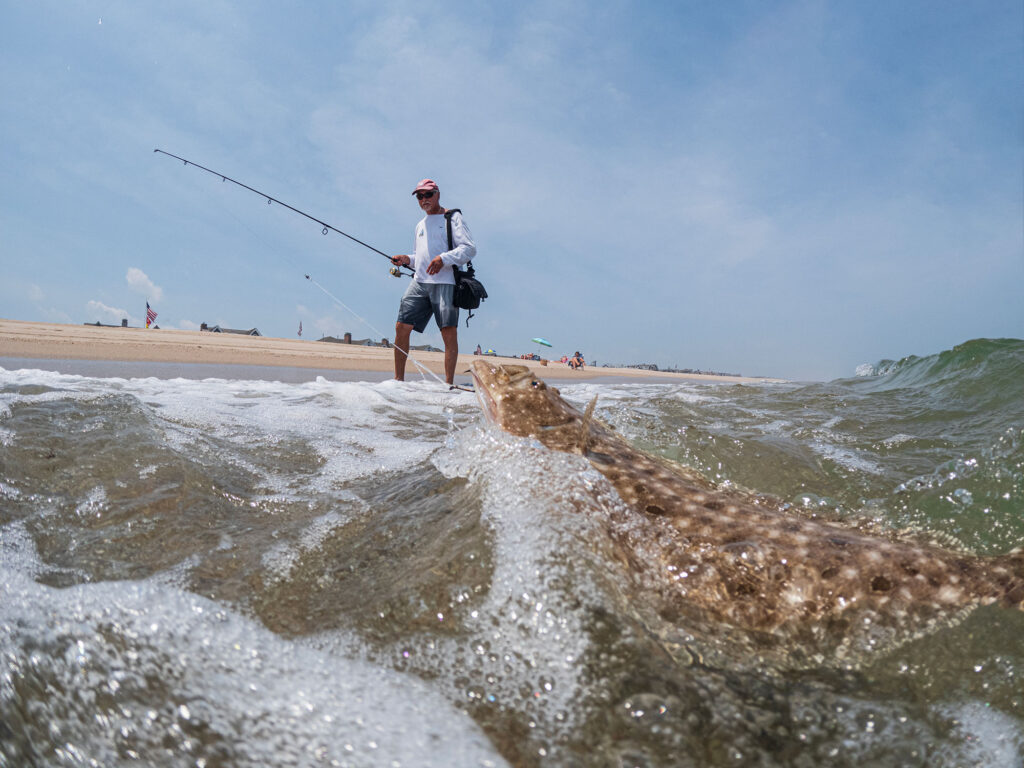
Summer flounder, or fluke, have all the attributes you’d look for in a leading role. They’re strange and mysterious, willing and cunning. They inhabit a wide range of environments, and their devotees follow them throughout the season like fanboys.
Despite the draw, fluke don’t get the same admiration as, say, striped bass or tuna, but they’re one of the most sought after saltwater fish on the East Coast, as evidenced by ever-changing minimum sizes and bag limits to keep the fishery healthy. Most of the fluke caught range between 15 and 22 inches, roughly 1 to 4 pounds, but when targeted on light spinning gear, they put a hearty bend in the rod punctuated by rapid head shaking.
They are challenging to find and fun to catch, and the fillets are a delight on the dinner table. It doesn’t matter if you’re a casual angler, a surf stalker, a pelagic prowler or a bottom bouncer, fluke are often top of mind when the season opens. They are the No. 1 summertime attraction from beach, boat or kayak in tidal rivers, bays and the ocean, but they are also remarkable creatures with a surprising life cycle.

The Fluke Doctor
Dr. Ken Able has devoted his career to studying fluke. He works at the Rutgers University Marine Field Station at the end of an 8-mile, poorly maintained road leading out into the salt marshes of Great Bay in southeastern New Jersey. The buildings were constructed in 1937 as Life Saving Station 119, which was operated by the Coast Guard until it was decommissioned in 1964. Abandoned, the station fell victim to fire, vandalism and decay until Rutgers purchased and revitalized it in 1972 as a field station for professors and graduate students to study the surrounding environment and the varied marine life that call this expansive estuary home.
Able holds a Ph.D. in biological oceanography and began his professorship at the Rutgers main campus in 1977. After nine years, he moved his office to the research station and has worked there ever since. He is the author of several books, including the 600-page, scholarly tome The Ecology of Estuarine Fishes: Temperate Waters of the Western North Atlantic.
“I’ve always had a fishy focus, and estuarine habitats fascinate me,” Able says. “I’m supposedly retired, but I can be found here most days working with post-grad students continuing research begun many years ago.”
Able showed me around the station in late March. The building sits on pilings out in the marsh — fish literally swim under his office at high tide. “You might be surprised to know that this area is one of the most pristine estuarine environments left on the East Coast,” he says. He calls it a New Jersey paradox.
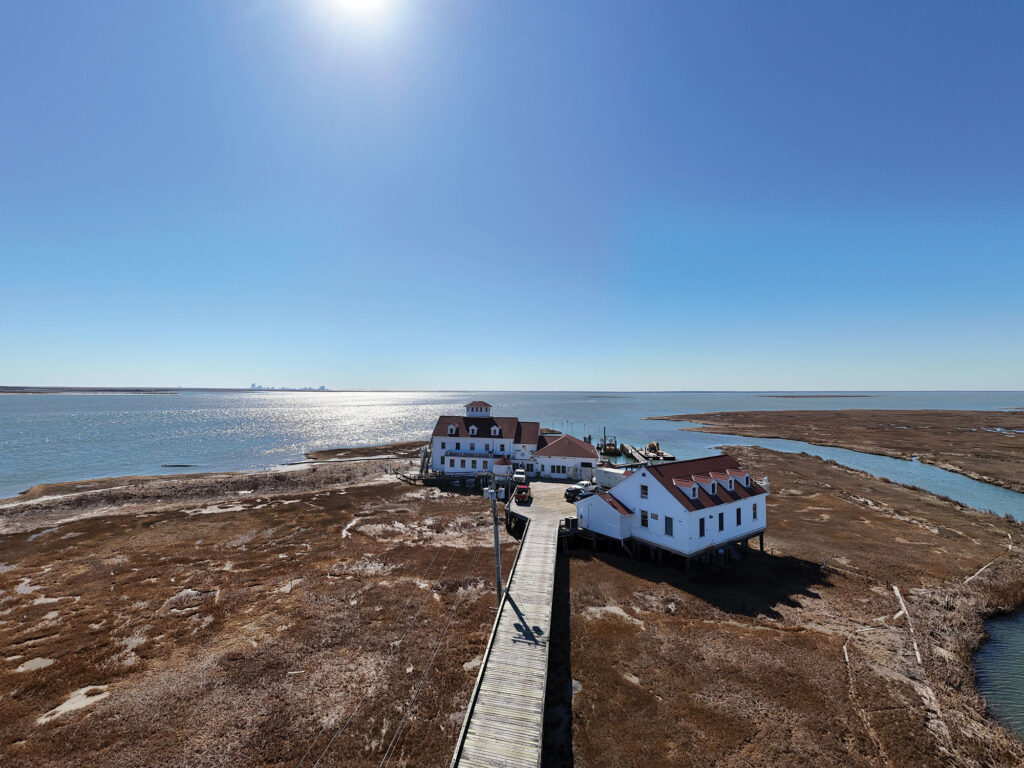
About two miles from Little Egg Inlet, the estuary is a patchwork of deep-cut channels and thousands of acres of creeks, sloughs, mud flats and marsh grasses that host a soup of marine organisms. Most are native to the area, but studies have found a variety of juvenile fishes from northern and southern regions at various times of the year.
The extensive datasets Able and other researchers developed include 38 years of weekly larval fish collections. They track larger fluke using surgically implanted RFID (radio frequency identification) chips that are read by underwater monitoring devices spread throughout the New Jersey bay complex, inlets and out into the ocean. Every time a chipped fluke passes near a telemetry monitor, it is identified much like a pet Doberman with an ID chip. The travels of individual fish are monitored, documented and incorporated into the data. The project is part of the Atlantic Coastal Telemetry network, and the data has lifted the veil on the life cycle and migrations of fluke.
Unlike many estuarine fish that spawn in brackish or fresh water, fluke got their signals crossed somewhere along their evolutionary path. The fluke does the exact opposite. As early as September, mature fish begin moving offshore in waves to spawn on the outer continental shelf. Able says the earliest spawning takes place closest to shore in depths of 30 fathoms, while later waves of fish swim farther toward the edge of the shelf. Fertilized eggs hatch into larval fluke, and by November, fry start showing up in Rutgers’ weekly surveys. Their half-inch bodies have begun to morph into a more recognizable flatfish, the eyes migrating to the left side of the head and the body flattening. But how do such tiny fish travel from way offshore to the estuaries so quickly?
“I was afraid you were going to ask that,” Able says. “The prevailing theory is they rise [up in the water column] to ride the tide toward shore and then drop back to the bottom when the tide ebbs. Their growth rate over the winter is slow, but as the water warms, they grow rapidly. By fall, they can be 10 inches long or larger.”
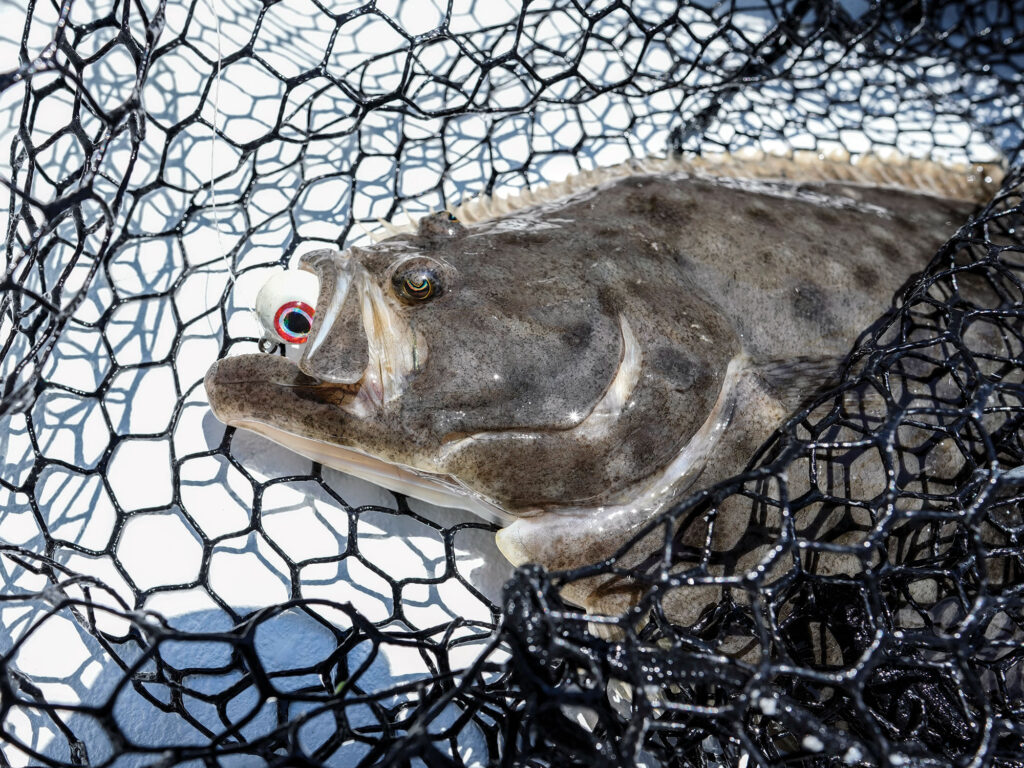
Able says fluke eat just about anything they can fit in their mouths. “In the estuaries, they eat grass shrimp, small crabs, killifish and small fish,” he says. “As they grow, the size of the prey gets larger. Don’t let their appearance fool you; fluke are aggressive predators with a mouth full of needle-sharp teeth. Their ability to alter color to match different bottom compositions makes them accomplished ambush hunters, but they will also chase down prey.”
On the Hunt
The best early-season fluke fishing takes place in the estuaries, where the water warms quickly and food sources abound. Adult fish start flooding back in March and April, and by the time the recreational season opens, typically in early May, fluke begin to feed voraciously.
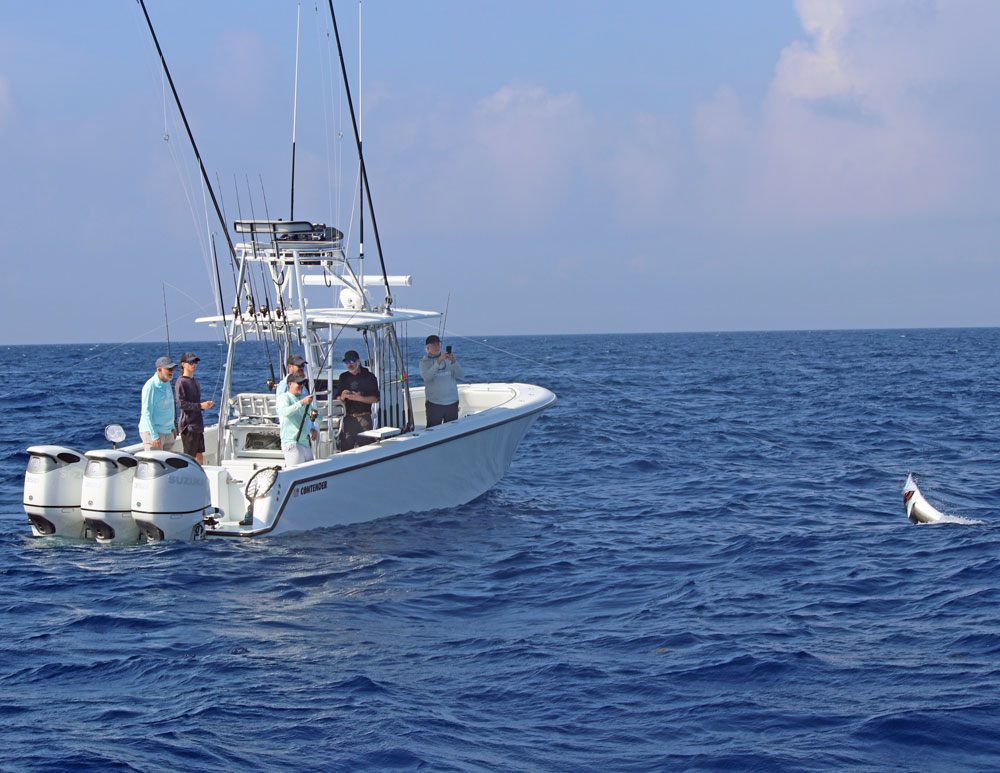
When it comes to tracking down the fish, few anglers spend more time searching for them than sharpie Tom Zambetoglou (Tom Z to anyone who has tried to pronounce his last name). The New Jersey native grew up fishing the bays and marshes north of Atlantic City and now runs a tricked-out 24-foot Yellowfin bay boat with a 350-hp outboard. The boat is packed with cutting edge electronics, a remote-controlled trolling motor on the bow and a pair of shallow-water anchors on the stern. He took me on a breathtaking ride through skinny-water channels and creeks at breakneck speeds to access some very flukey spots.
“I love fishing in these beautiful surroundings, and the wildlife that inhabit the estuaries is amazing,” Zambetoglou says. “The best back-bay fishing occurs during a 10-week window from the season opener in May to the second week in July. After that, the larger fish migrate back out into the ocean for the summer and fall. The way we fish for them has changed, and pretty much guarantees we will get bites and always have a shot at coming home with a 7- or 8-pounder.”
Zambetoglou started chasing fluke when he was 14; now 52, he has seen many changes in the pursuit of doormats. “We would try and drift the narrow channels dragging 2-ounce sinkers and fluke rigs baited with squid strips and killies, but we were always at the mercy of the tide and wind. Our boat would get pushed up onto shallow flats regularly, and maintaining a fishable drift speed was almost impossible. Our rigs got covered in seaweed, but we still managed to catch a few fish.”
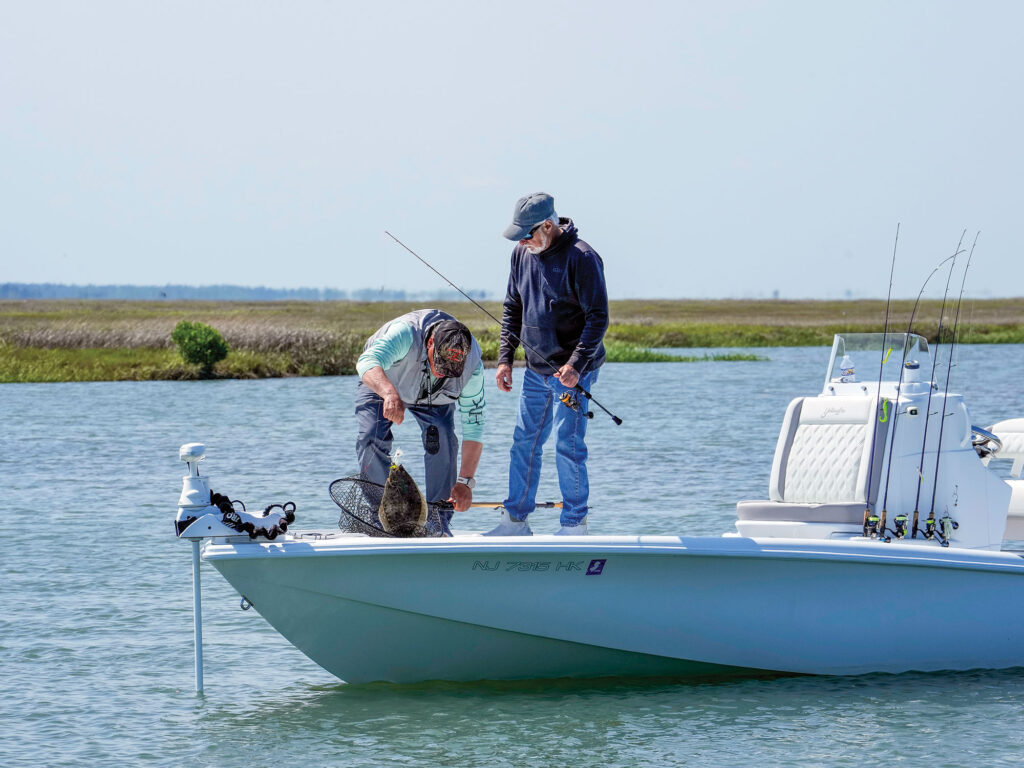
The advances in trolling motors have helped him, and a fleet of boat owners, stay on the bite. “I got my first electric trolling motor in 2009 and started experimenting with using it to control drift speed and direction,” he says. “That gave us the ability to develop a more tactical approach, and our catch rates started to rise.”
Zambetoglou fishes with a rod in one hand and the trolling motor remote in the other, constantly monitoring his drift speed and direction while jigging a high-low rig. He works the channels with precision, barely maintaining a drift speed of 0.5 to 1 mph.
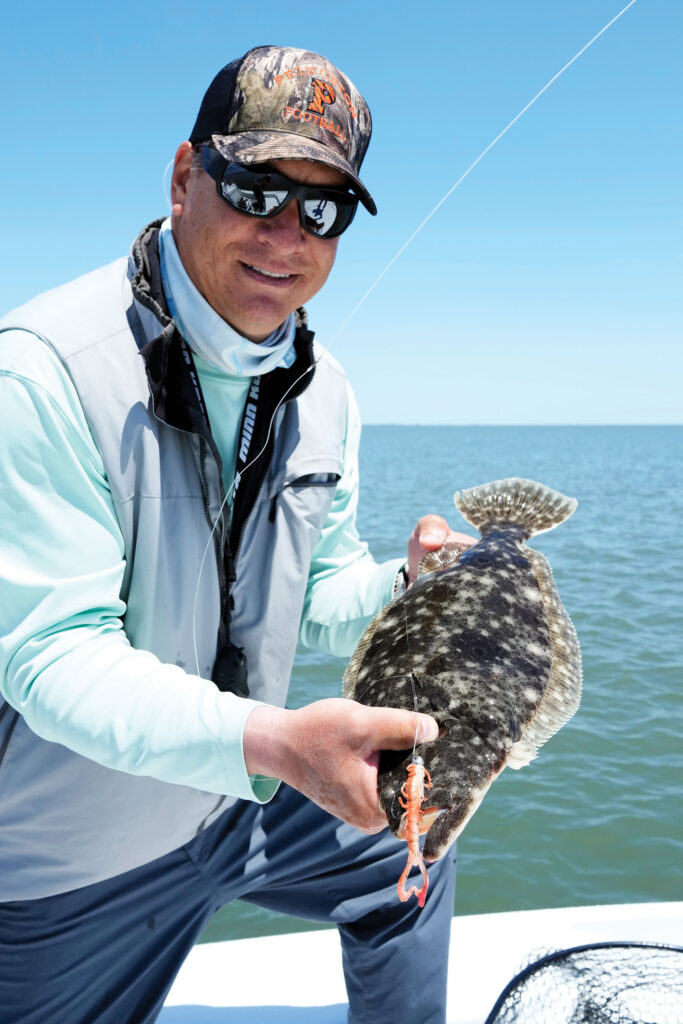
He prefers a short spinning rod, less than 6 feet, with a fast tip to detect bites and a more powerful midsection for immediate hookups. He constantly works the jigs and baits, rapidly twitching the rod tip. His typical setup is a two-hook, high-low rig with a 1-ounce bucktail and Gulp Grub or Mullet on the bottom, and either a 4/0 Octopus hook with a live killie or a 1/8th-ounce bucktail with another Gulp trailer rigged off a dropper loop about 15 inches above. Zambetoglou admits that scented Gulp jigs have changed the game. “The stuff works better than any natural strip bait,” he says.
The technique translates well to any estuary environment, including farther south, where southern flounder (a close relative of the summer flounder) are found. It also works in the ocean once the main body of fluke exits the bays. Deeper water means upping the size of the jigs, but the high-low drift approach remains the same.
The Fluke Gangsta
To learn more about ocean-fishing for fluke I spoke to Stan Gola. The fluke-obsessed angler wears his emotions on his sleeve in the form of a full-color tattoo depicting a fluke chasing a bucktail. “I’ve been fishing for fluke since I was a kid and love it more than ever,” Gola says. “I started on the long-gone Long Branch Fishing Pier, and later with my dad on his tin boat.”
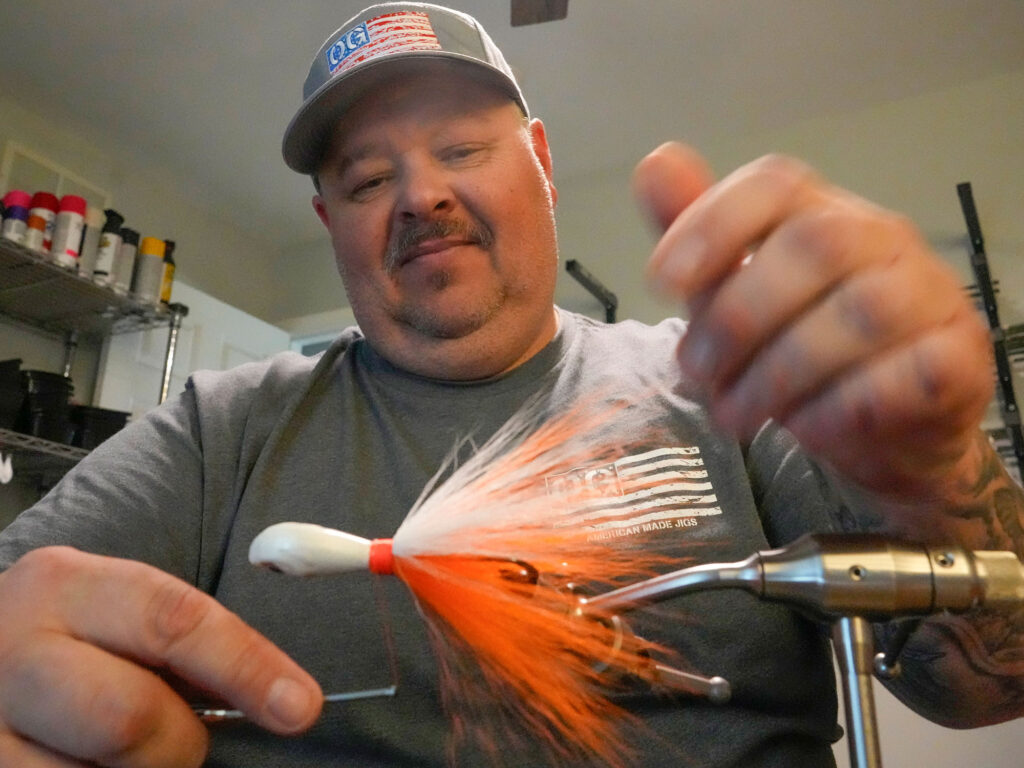
In 2007, Gola founded S&S Bucktails, selling jig designs to tackle shops from the Mid-Atlantic to New England. And he recently launched O.G. (Original Gangsta) Jigs. “I design and manufacture a whole line of fluke jigs dressed with natural bucktail or rubber skirts, all made here in the U.S.,” he says.
Gola takes his pursuit of fluke to a competitive level, fishing tournaments from mid-May through mid-August, and his team has an enviable 40-plus wins. He starts fishing as soon as the season opens, targeting them in estuaries and then moving to the ocean — where he rules.
“Ocean fishing has changed in recent years,” Gola says. “Fluke have become more structure-oriented, and we find more fish in deeper water during the summer months. Artificial reefs with low-lying rubble, rocky areas, even wrecks when fished carefully produce more and larger fluke. It takes dedication to find where larger fish are concentrated, but once we do, we pound them, short-drifting the spot over and over.”
Gola is a bucktail specialist and has some excellent advice. “I think the biggest mistake anglers make when ocean-fishing for fluke is they don’t adjust their technique with changing conditions,” he says. “When wind and current give you a slow drift, use lighter jigs and a more aggressive action. The technique is called snap-jigging, making the jig jump with faster and higher lifts of the rod. When the drift is fast, switch to a heavier jig and slow down the action to a more subtle up-and-down swimming motion.”
Gola also uses Gulp plastic tails but will use strip baits cut from mackerel, bluefish and false albacore if he can get them. “I don’t use squid strips because fluke get them off the hook too easily,” he says.
Gola uses a high-low rig with a bucktail on the bottom and a dropper with a Mustad PinGrip hook for strip baits. The dropper is long, so it rides above and behind the bucktail to give a hungry fluke a second chance if the bucktail passes by. His go-to jig and tail color is white glow, but he also uses pink at times. “Around the full moon, fluke feed heavily on crabs, so I use jigs and trailers that incorporate brown and orange,” Gola says. “I make a jig called a Ragging Rattler that has two small rattle chambers that subtly mimic the sounds made by crabs moving along the bottom.”
Fluking the Surf
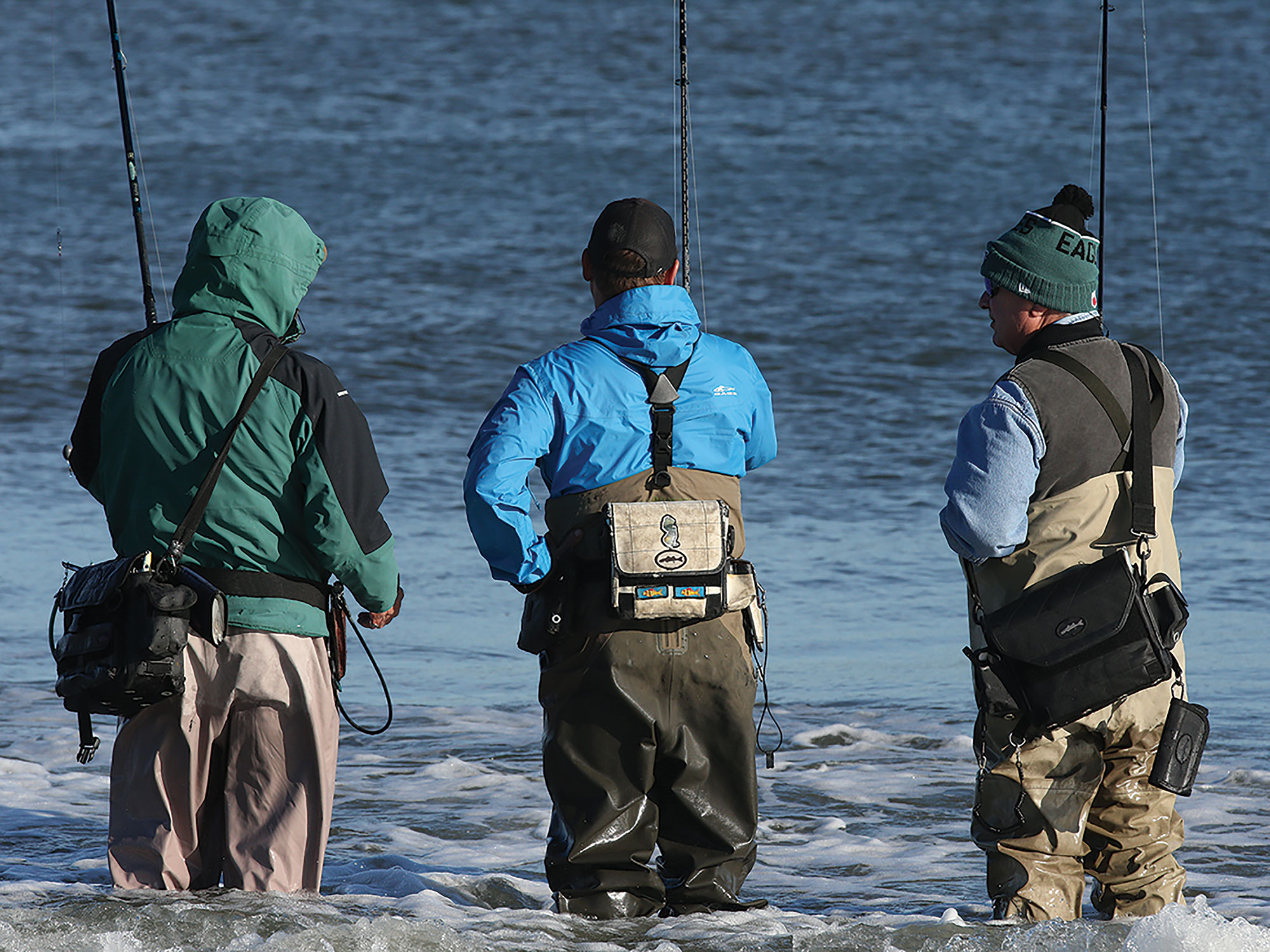
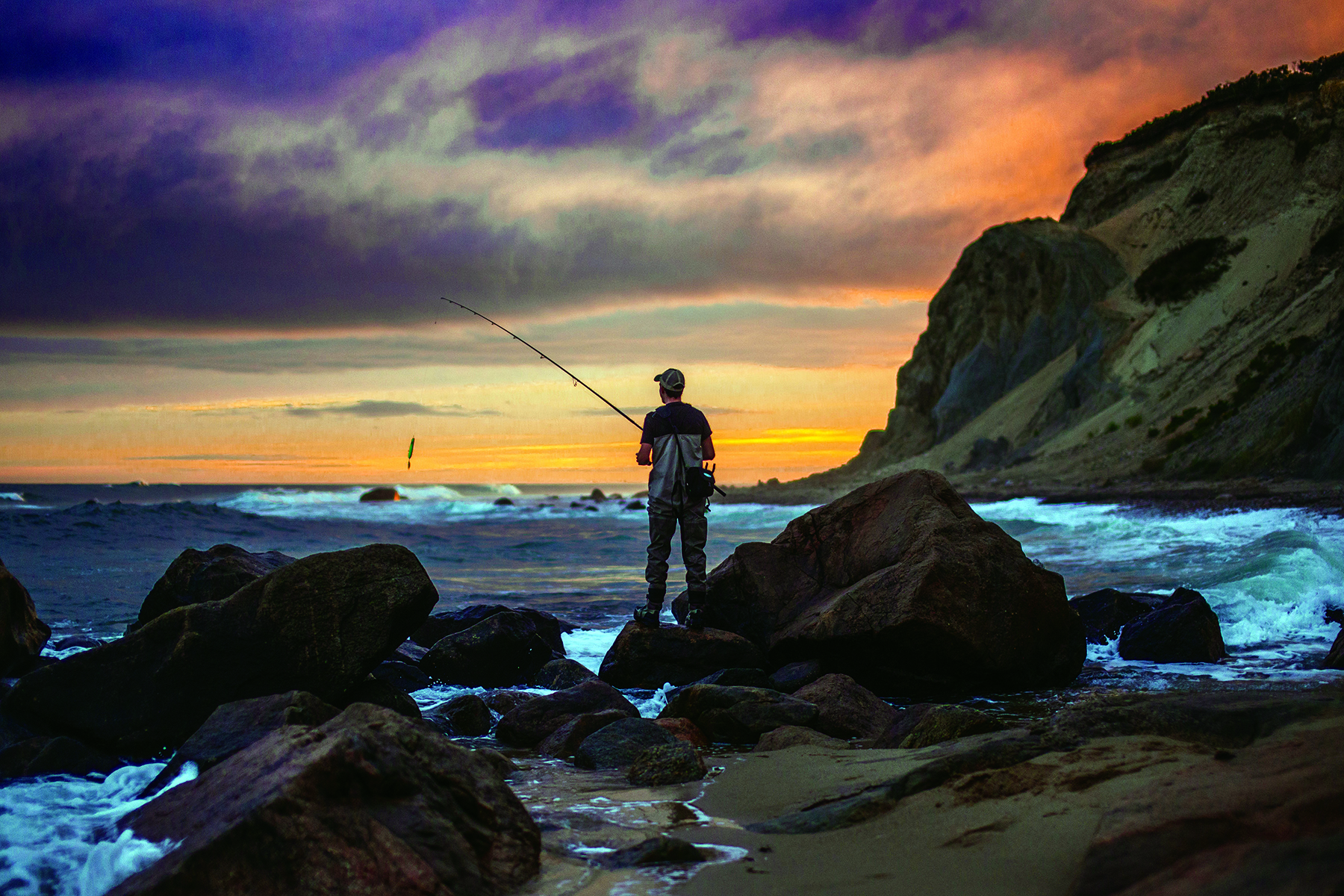
Surf anglers get their shots at fluke, but unlike casting for striped bass or bluefish, the tackle used is lighter, the presentation more delicate, and long casts are rarely required. Jerry Fabiano, a retired NYPD detective, has made catching fluke with his feet planted in the sand something of a science.
“I grew up on Staten Island and spent so many days fishing my parents called me Nature Boy,” Fabiano says. “But once I started working, fishing fell by the wayside. When I became a detective/supervisor, I started again, and after retirement, I moved to Ocean County, New Jersey, and fell in love with surf fishing.”
Fabiano lives a mile from the beach in Mantoloking and spends a lot of time mapping the best places to find fluke. He times the tides, which he says is important to his success, but not all his surfcasting is close to home. He fishes from Sandy Hook National Seashore in the north to Island Beach State Park, about 50 miles of oceanfront, and he says most of his bigger fluke come from the more northern beaches.
“The key to finding fluke is taking the time learn a beach,” Fabiano says, “and the best time to do that is at low tide when you can see the bars, breaks and troughs clearly. I look for breaks in the bars that create a natural pathway for fluke to come into the slough where bait gets trapped. The best time to fish those spots is on the incoming tide. I start by casting to the south side of an opening in the bar because it is a likely ambush point. Then I work around the entire mouth of the break and the trough between the beach and the bar. If I don’t get bites, I walk to the next spot.”
Fabiano fishes an 8-foot rod with a light tip and braided line for maximum sensitivity. He fishes a rig of his own design, a takeoff on a high-low rig that works better from the beach. It incorporates a flat, 1-ounce sinker with two droppers, one that rides close to the bottom and another that trails farther back. He uses free-floating baits or scented soft plastic grubs on 4/0 hooks and works the rig very slowly, dragging the sinker along the bottom up to the surf line. Fluke often move right up to the wash looking for baitfish and sand fleas.
“You catch a lot of shorts from the beach,” he says. “I barely take them out of the water, removing the hook while the fish is laying on the sand, and then nudge it back into the waves with my foot.”
No matter how you fish for fluke, the fight and fillets never disappoint.