Tarpon are cruel, wicked fish.
Before I started fishing for them, everything I’d read or seen gave me the impression that they are majestic, cunning and beautiful. Yes, they are all those things, but those are not their dominant traits.
Deep in the night, from shore, in the hard-running currents that cut between the islands of the Florida Keys, tarpon are evil incarnate. The grace and glamour they display on the flats is stripped away, and they become demonic. It is not their fussy nature or the copious, superfluous violence of their fight that I struggle with the most. It is the space they occupy that makes them so sinister: Bridges are their lair.
Each bridge has a unique personality. A cursory glance suggests many are the same, but that is false. To fish one is to know only that place. Some bridges I love and respect, even if I know those feelings are unrequited. The structure of these bridges makes logical sense to me, and each offers space to land a hell-bent tarpon. I can see the water that churns underneath in four dimensions — the physical space the water occupies, how it interacts with the man-made structure, and how this changes as the tide floods and ebbs. It’s mapped and imprinted on my brain, and when this blueprint intersects with the right environmental conditions — wind and moon, mostly — I can sparingly achieve success. When I’m under these bridges, plying their margins, I am all optimism. Under these bridges, I can win.
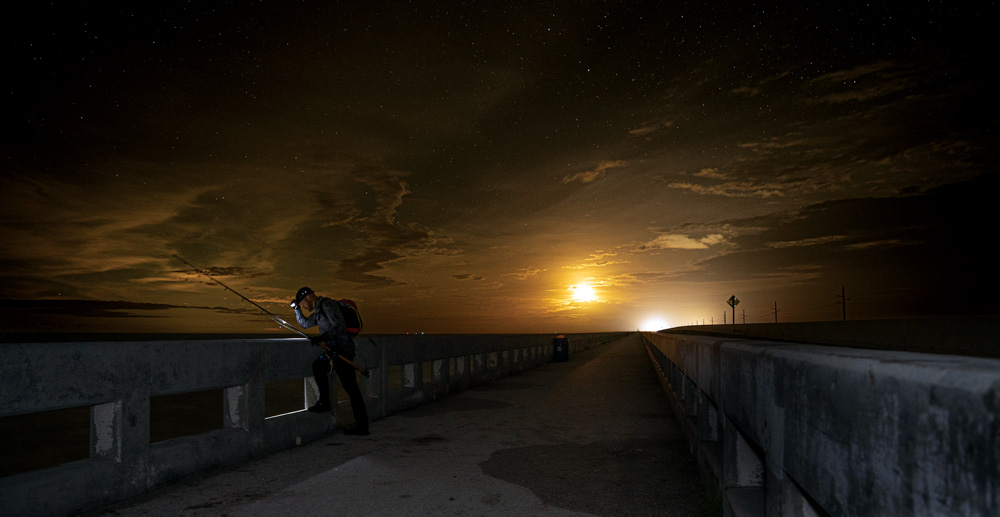
Then there are cruel, sadistic bridges that are traps. They are like a delicious meal that is laced with poison, but I am starving to death. It’s not that these bridges don’t hold fish. It’s often the opposite. Some nights, I can see or hear hordes of fish. And these wicked places have all the elements to make them a feast of outrageous proportions. Currents drive hard around the pilings, disconnecting and weaving back together, with eddies and seams galore. Bait is omnipresent, and while the type may change with the tide, there is always something. During the full moon, a shadow line runs through it all — the final ingredient. Tarpon stack up on the dark side of the line like a vanguard. Their attacks echo off the concrete and steel. The sound drives me to madness. Each pop and blast cuts through my body like a siren’s song, forcing me to try to land tarpon in these forsaken places.
Therein lies the problem: Landing these absurdly powerful fish with so much current and structure, and little room for error (or space for the fish to run), is worse than a roll of the dice or flip of a coin. But the potential for glory is so high that I saunter on, scuttling back and forth along the rocks, grass and garbage strewn haphazardly on the bank. I try to make the angles work deep into the night and get the drift right from a place where I can also steer and land the fish. I am perpetually wild-eyed and gritting my teeth, angry and exasperated. I know I should move on, that I shouldn’t even try, but like an addict, I can’t. I incessantly recite: It is possible.
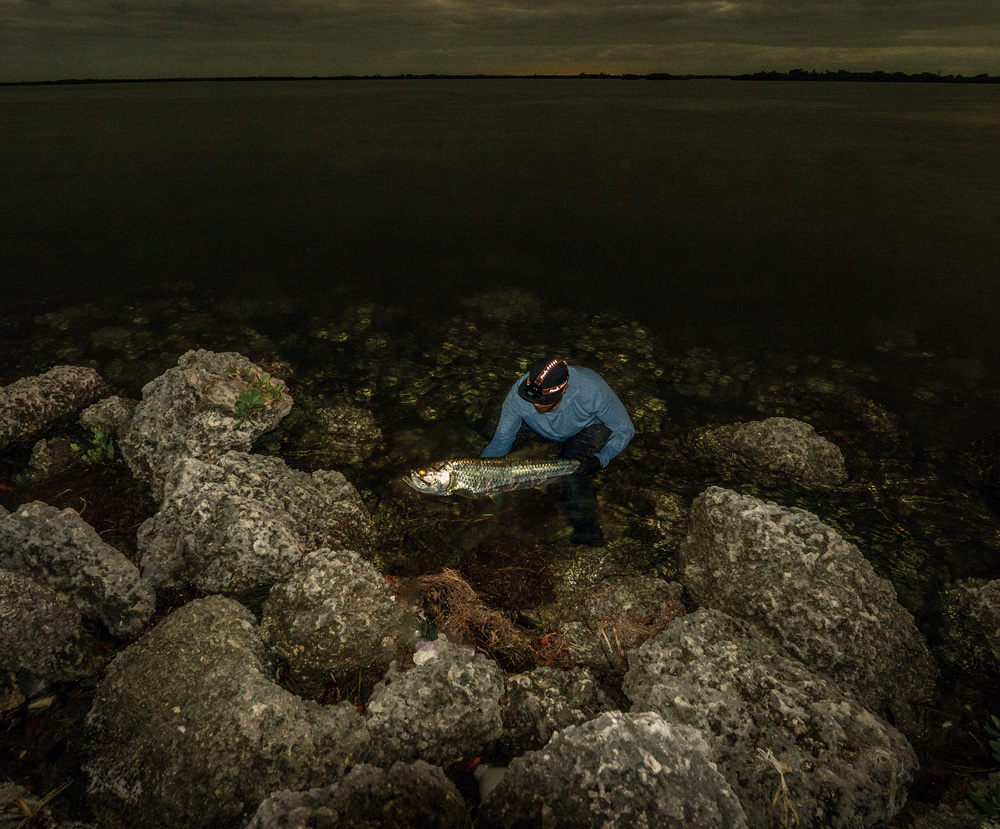
Like a villainous dealer, the bridges give up enough tastes to keep me hooked. Small fish are achievable, and I land many. The big fish are here, too. I can hook them. I can slide a soft plastic into the shadows and come tight, but that is an illusion of success, something the bridge offers to keep me there, suffering. Once I hook the big fish, they work with the power of God (the ocean) and man (the bridge) to invariably break me off.
The worst is when a hooked fish comes screaming out away from the bridge and doesn’t just turn and burn under it. This feeds my delusion every time, and I think I can win. Call it blind, hopeless optimism, but I believe it. Invariably, however, the fish will turn — 15 seconds or five minutes in — and head down-current under the bridge, taking my ego with it. Hooking the fish is an accomplishment, I guess, but no amount of pulling and cursing is enough to yank it away from the snags and the hard-and-sharp structure, seen and unseen. No matter what I do, my braided line seems hypnotized and ends up pinned to the side of concrete, wood or steel. Maybe it’s a nod to the intelligence of the fish, I do not know. But when the line breaks, which it almost always does, so does my heart.
So why stalk these bridges? Hope may be just a glimmer, but it is eternal. I struggle through the nonsense because, every once in a while, Lady Luck taps me on the shoulder, and the fish that finally comes to hand is pure sensualism. It’s like sex for the first time. Landing a fish in these infuriating conditions cannot be re-created or overstated. There is no hyperbole. I could simply fish elsewhere, but I have a hunger to beat these cruel bridges. I stop and scramble down the bank to give it one more try. Maybe tonight’s stop will be the one where I figure it out. Probably not. But I’m going to keep trying.
RELATED STORIES: