When I first took up fly-fishing, it seemed life would be complete, or nearly so, if I could fish those places that enthralled anglers in the pages of the popular fishing publications of the day. I wanted to double-haul into the teeth of a Patagonian wind like Joe Brooks, or lay down a dry fly on an English chalk stream, its grassy banks as carefully clipped as the 15th hole at Augusta, or offer up a few deceivers like Lefty Kreh, shoehorning back casts between passing cars speeding along a bass-filled Everglades canal.
As a fishing journalist, I was able to fulfill many such dreams: Christmas Island bonefish on Christmas Day, Atlantic salmon in the aquamarine waters of Iceland’s Midjfardara, tarpon at sunrise in the Marquesas. It wasn’t until the quarantine brought on by the pandemic of 2020 that the realization hit me that such lists are often esteem-boosting scorecards, the theory being that the more places you can check off, the closer you come to fly-fishing satori. When the world shut down, that trip to New Zealand for the mouse hatch would have to wait. Big browns slamming salmon flies on the Madison could enjoy the hatch without me in the mix. My longtime fantasy of eating an onion sandwich a la Papa Hemingway, while fishing for black trout in the Pyrenees, would be put off for another season.
 Quarantine and travel restrictions gave the author a renewed appreciation for fishing around the Big Apple.John McMurray
For two years, such dream trips were, of necessity, put on hold. There would be no flying in my fly-fishing. But for the moment, there were 566 miles of New York City coastline and its rich, estuarine waters extending 100 miles offshore to where the Hudson Canyon falls off into bottomless blue water.
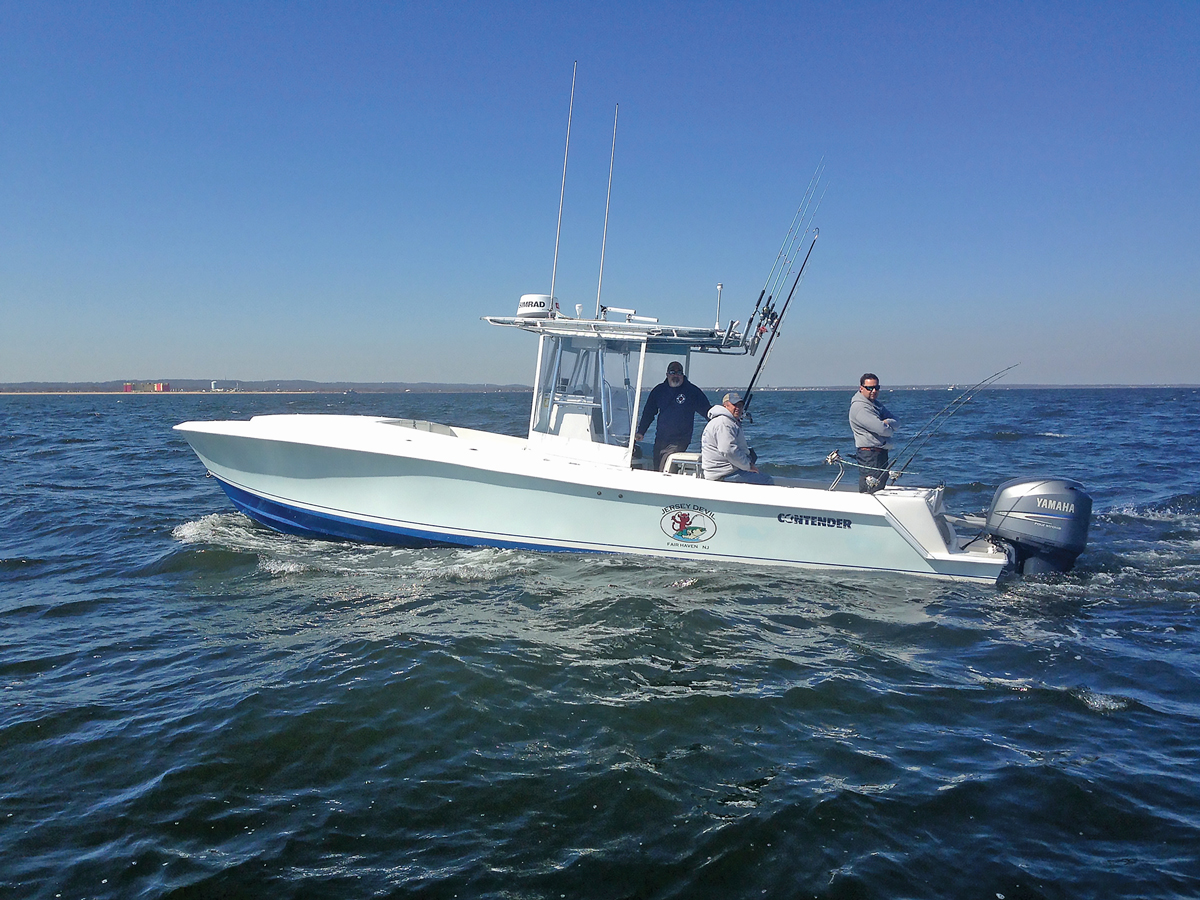
Some of my friends kept boats on Mill Basin at the end of Flatbush Avenue in the Canarsie section of Brooklyn. From their moorings at Sea Travelers Marina, it was a short trip to Jamaica Bay, the rip just off the Parachute Jump at Coney Island, the south shore of Staten Island and over to Sandy Hook, New Jersey. For some reason that I have never fully understood, the nearest thing to a guarantee of fish is the bay right next to Runway 6 at John F. Kennedy International Airport.
Quite often the stripers will drive bait right up against the shore. It was hard — impossible — to resist the temptation to move closer to them than the 600 feet enjoined by airport security. As if they’d read the memo, the fish appeared to know that they would not be molested as they corralled bunker within the no-boat zone. Inevitably, you’d creep over the line a bit, and sure enough, a police patrol boat would motor up from its holding position by the trestle where the A-Train crosses Broad Channel to Far Rockaway. In the tone of weary disappointment that parents reserve for a child who has let them down, the harbor police would share some variation of,
C’mon, guys. You know you can’t be here, and we know you can’t be here, so why are you busting our chops? Very NYPD.
 Urban fishing around JFK airport is a surefire way to find some striped bass and unwanted attention from airport security.John McMurray
My special fish entered the scene Nov. 11, 2021, Veterans Day. I was fishing with Kurt Schwarz, one of my regular fishing partners, and we had covered all of Jamaica Bay. There was plenty of bait, and under the bait balls, beaucoup bass marked on the fishfinder. But they weren’t eating. We waited out the tide and, still, no customers. Reluctantly, we began the journey home, hoping to see birds working, but apart from a few clueless terns, nothing was happening. We passed the huge landfill where the city has planted grass and trees and created a park named after Shirley Chisholm, the first black woman elected to the U.S. Congress.
I had given up on the day when Kurt cut the engine on his Maritime Skiff and picked up his binoculars. “Let me check out the creek that feeds in here. I think I saw birds,” he said. Kurt is both an optimist and indefatigable.
“Sure,” I said, by way of implying let’s get this over with.
“Maybe something there. Hard to tell. Let’s motor up the creek, nice and slow,” Kurt responded.
We eased up the creek at barely more than an idle, hardly pushing water or throwing a wake. It looked fishy. If you blocked out the occasional out-of-commission shopping cart tossed up by a storm surge, the scene had the look of an Everglades canal, high-banked and maybe 60 feet wide. Enough room for a back cast, but not much of a haul. “Worth a few casts,” Kurt said.
He handed me his rod, an 8-weight with a big foam popper tied on. My cast landed on the bank. A little wrist action coaxed it down at a break in the weeds. On the retrieve, the popper made slurpy, sloppy burbles. Whoosh! The biggest striper I’d seen that year reared back and made for the near bank. Then the far bank. Then under the boat. Then around the stern, forcing me to raise the rod and my arms to clear the outboard. Kurt coached my every move as if it were the first time I’d ever hooked a good fish. Or maybe he was just cheering me on. Or both.
When I tell this story, I have taken to calling the beautiful striper a 15-pounder, but angling memory casts a magnifying lens. Surely, though, it was a serious fly-rod fish and as satisfying as any I have caught after traveling 10,000 miles.
I drove home along Brooklyn’s still-shady streets, the leaves a mix of summer green and autumn gold. I stopped on the way for a cold beer and an order of fried calamari with spicy marinara. As often happens with fishing, a melody began to play on my inner jukebox — a tune that Billie Holliday recorded, with lyrics that could have been written for this day, laid back and jazzy:
You’ll find your happiness lies
Right under your eyes
Back in your own backyard.