The Lucky Side
We leave the ramp around 7 p.m. and head out to find our honey hole, a place we just call “the hump.”
It is a small mound of strewn boulders in about 40 feet of water, on the edge of a busy channel in southern New England. It was never easy to find, not in the Loran days. Despite our best efforts, we could never locate two ranges that worked. We only fish it after dark. It’s a verifiable big-striped-bass spot known only to a handful. How I learned of it is a story for another day.
When we get close, we start turning in ever-tightening circles. The bottom finally shoots up on the sounder. We’re satisfied that we’ve found it. We slowly motor southwest over the narrow debris ridge, and I deploy 70 feet of parachute cord, anchor and float with reflective tape. The buoy helps keep us oriented. Still, it often takes a few drifts to know for sure that you’ve got it just right. Close is not good enough. You’ve gotta be right on it.
We’re drifting live eels on three-way rigs, with 5 to 8 ounces of lead, depending on current.
Bruce gets hit, but looking at the eel, it appears to have been a bluefish, which we don’t often find here. I get slammed next and bring up 2 inches of eel head. On both drifts, the hits come after we drift too far past the boulder pile.
Bruce finally nails a nice striper in the teens, well-proportioned with a fat gut. Things are looking up. We make several more good drifts, which yield nothing. The night is young, and we’ve also got our casting rods with us. It’s been a disappointing, slow pick so far. Bruce is getting itchy.
“How long do you want to do this?” he asks.
“A little longer,” I suggest.
Bruce says we’ll make one more drift. After that, we’ll move and cast eels tight to a little island farther west that sits smack in the middle of a strong current stream. As we know, one more drift or one more cast sometimes does the trick.
Bruce lets out a little grunt as he sets up on a decent fish, which quickly rockets to the surface while he cranks like mad. The bass circles the boat, then surfaces again off the bow, where it thrashes the water once more. I remember what an old buddy told me: “The big ones come to the surface.”
The fish dives again. I suggest that it’s not too big when it breaches once more. “I don’t know,” Bruce says, “he’s moving an awful lot of water.”
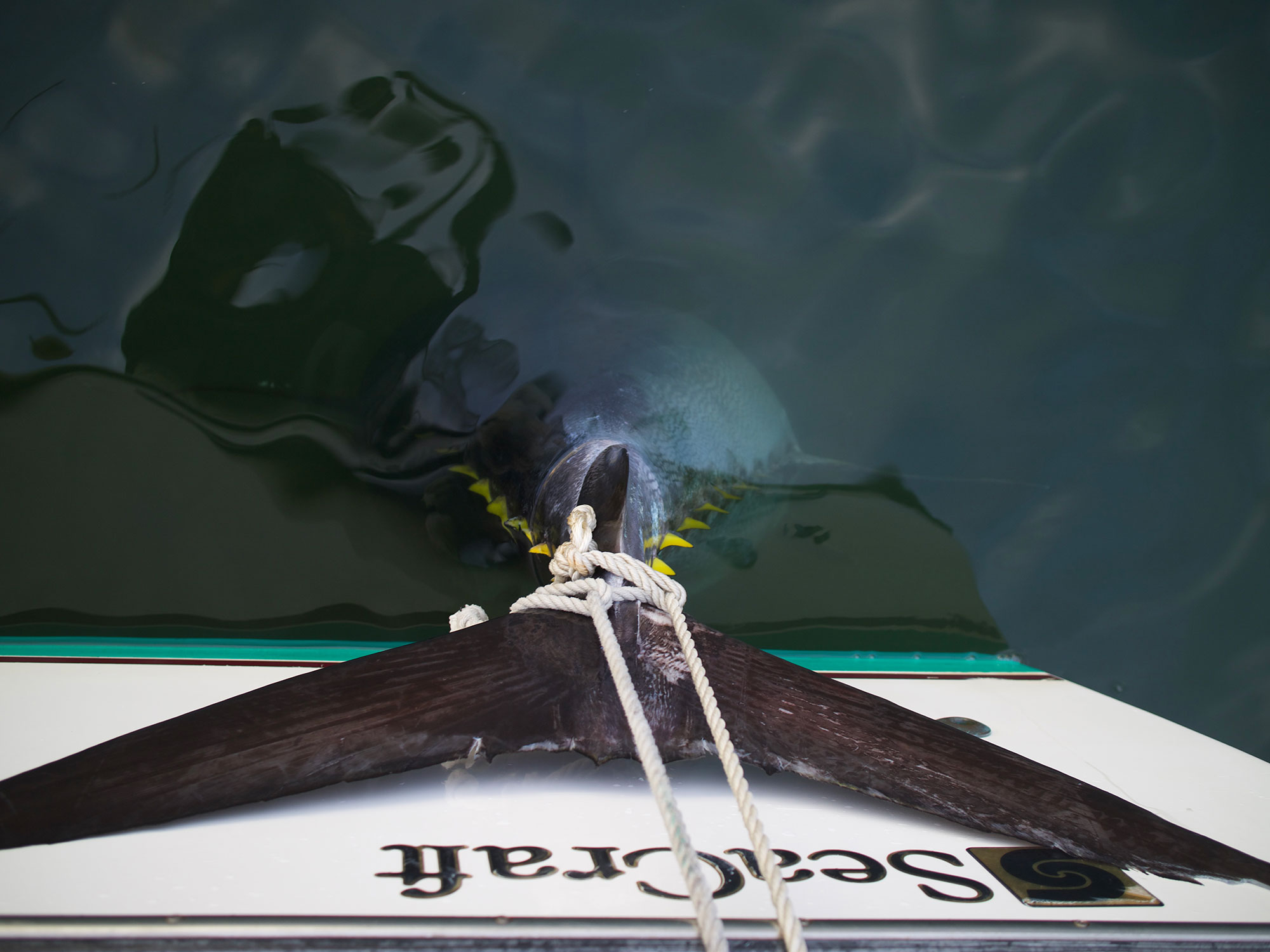
As soon as I see the fish in my small light next to the boat, I realize I’m wrong. “Shit,” I say, “that’s another 40.” The bass weighs 44 pounds and is hooked in the jaw. She is beautifully proportioned: large, olive-green head; heavily armored gill plates; shiny, striped flanks; powerful tail.
We spend nearly a half-hour reviving her. She is slow to regain her strength, and I get frustrated. I want to fish. “She either swims soon,” I threaten, “or she’s going in the fishbox.”
We work her back and forth gently beside the boat, and when her jaws tighten on my thumb, we assume she is ready to swim. Twice we release her, and twice we motor back when she pops to the surface in the beam of our spotlight. The final time, we hoist her back into the boat and release her head-first like a torpedo so that she plunges into cooler water, and her tail can get a bite. She stays down.
Fishing is funny. We resume, and I tell Bruce that I’m commandeering his side of the boat on the next drift. I land two bass in three drifts, both in their 20s, the largest going 26 pounds. I did a play-by-play on the first drift from the lucky side. “This is how I want to image a big fish taking the eel,” I tell Bruce, with whom I have fished hundreds of times. “Once he senses it, he scoots right over to it, racing the smaller fish with a big thrust of its tail … just like that!” I say, grunting as I set the hook on my largest of the night. Bruce laughs and laughs.
It’s Friday night, and the launch ramp around midnight has a dozen guys in several parties milling around and tying down their boats. There’s a group of four guys huddled together, two of them filleting two bass. I don’t say anything. As Bruce backs the trailer down, they guy doing the most talking finally asks how we did.
With my light in my mouth, I answer: “OK.”
“Bass?”
“Yup,” I say.
“We got two. How about you guys?” he asks.
“Four,” I grunt, the light still in my mouth.
“Two?” he asks.
I take the light out. “Four,” I say.
“That’s pretty good. Any size to them?”
“Yup, not bad.”
“Keepers?” he asks.
“Yup.” I knew the next question.
“How big?” he asks.
“Forty-four pounds.”
“All of them?!” he asks, excitement in his voice.
“No, the others were nice, but not that big.”
“You don’t mind if I ask you where you caught them, do you?” “No,” I said. “I don’t mind. Out on the reefs.”
Anglers Journal executive editor William Sisson is the author of Seasons of the Striper: Pursuing the Great American Gamefish (Rizzoli Books, 2022).